Wednesday, April 24, 2013

Cute Canines - Eyes That Engage You

My mother adored cats, and I was brought up with felines of all fur colors, temperaments ranging from cuddly to haughty, taking control as they do all over the house. But my wife hates cats, so it’s been dogs during my married life.

I’ve gotten to really like dogs, and I’m in good company. For example, British prime minister Winston Churchill in the movie The Gathering Storm is pictured one day sitting in the farm section of his country property pondering the animals around him. He comments to an approaching visitor:

“You know, a cat looks down upon a man, and a dog looks up to a man, but a pig will look a man in the eye and see his equal.”

I don’t know about pigs, the closest I’ve ever been to one is while eating ham or bacon. Can’t say that I’ve eaten cat or dog (knowingly at least, but then again I have been to parts of Asia).

The dogs that we’ve had have always been cute and devoted. What is it about dogs that makes them into “man’s best friend” as is generally accepted?

Of course, there’s the services they faithfully carry out for us: watchdogs, seeing-eye dogs, wartime duty, lifesaving, farm dogs effortlessly shepherding sheep, and much. much more.

But it was an episode of the outstanding Catalyst science program Australian Broadcasting Corporation (ABC) that put forward another fascinating insight. Catalyst features stories about dogs every now and again.

For example, there’s this story about dogs’ eyes:

It was thought, that like humans, all dogs have the same eye structure and see the world the same way. But Australian researchers have discovered that dogs had a completely different retina. Amazingly, it means different dogs see the world completely differently.

All very interesting, but it doesn’t answer my question of why, of all domestic animals, dogs seem so cute and appealing (compared with cats, especially).Dogeyebrows_small

It seems that there could be a good scientific reason for this. There’s now a plausible theory that it all has to do with dogs’ eyebrows.

Watch the video, and read the transcript.

Are you convinced?

Saturday, February 16, 2013

Do husbands and wives ever fully understand each other?


Now that really is a basic question!

Thanks to Scott Hilburn’s “Wife of Pi” comic of 08 February 2013 for leading me to ponder this most problematic of matters:

More of his works at The Argyle Sweater.

Sunday, February 10, 2013

Is perfection achievable?

That’s a pretty decent ‘basic question’ is it not?

I got to thinking about it after coming across the following article:
Don’t Let Perfection Be a Barrier to Improvement

If you know of something that can be done to make a process better and you intentionally choose to leave the issue unresolved, you are violating the principle of zero defects. But if you overspend your resources for a small gain when there is a bigger gain available somewhere else, your actions violate the ‘better, not perfect’ principle.

So, which is right?

I suggest that you read this short article too, including the comments.

Tuesday, December 04, 2012

Aussie 8-year-olds learning atomic structure and the Periodic Table

Before I joined IBM Australia in 1970, I spent most of the 1960s teaching Chemistry, General Science and Mathematics to older high school students.

A couple of times at the start of each year I would take classes of junior grade kids newly arrived from primary school. I always admired their freshness, openness and willingness to learn – that is, before years of high school regimentation wore off some of that freshness and keenness.

After more than forty years in the IT industry, I am attempting to undertake a broad-brush relearning of all things scientific, on various aspects of physics, chemistry, life sciences, cosmology, climate science and other things that have developed so much over those four decades and still intrigue me.

image

This includes wondering about how high school science teachers go about things these days. So I was extremely interested in a segment earlier this evening in the 7.30 program on ABC Australian television.

Physics and chemistry are the bane of many a high school student, but what if we're pitching the ideas to them too late? Can eight-year-olds absorb atomic theory? One teacher has asked that question in a bold experiment at a Brisbane primary school. And he says it shows young minds are much more advanced than we think.

Read the transcript and watch the recording here… Weird science reveals more advanced students … I think you’ll be surprised, or even a little amazed.

image

Tuesday, November 06, 2012

What causes Ice Ages to come and go?

Anyone who thinks that climate science is straightforward has “rocks in their head” (a term coined by geologists, perhaps?).

Because I’m flat out trying to keep up with changes in the computing and IT world, so don’t pretend to have the time to be anything more than an interested part-time observer of what’s going on in climate science (and cosmology, and mathematics, and physics, and chemistry, …).

I’ve been following meteorological science at a distance for half a century or so. The models for prediction of next week’s weather certainly do seem to be getting more accurate and reliable, yet still with the occasional surprising miscalculation: storms on a predicted sunny day, or vice versa. Extend the time scale to next month or next year and the same can’t be said, so complex are the relationships and so dependent are the models on the various assumptions upon which they’re based.

When you go from weather science to climate science, not only are the time periods so vastly longer but also the underlying assumptions are more debatable, the geographical scale so much wider and the measurements so much harder to obtain that the predictions flowing from the climate models by their nature must be rather uncertain.

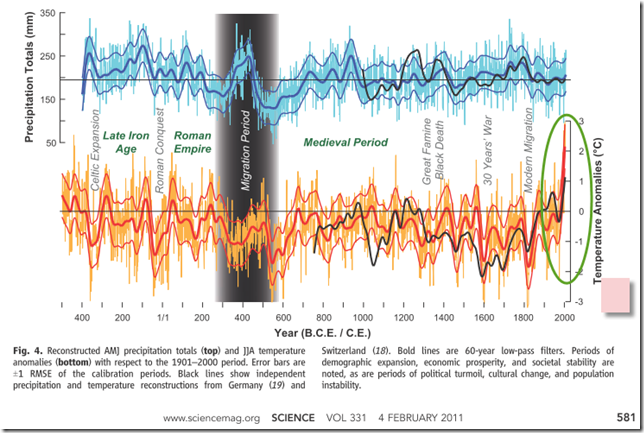
I was reminded of all this when reading Unlocking the secrets to ending an Ice Age with its several charts of the type that I commented upon in this blog a few years ago (for example, The rattlesnake’s rattle).

I don’t class myself as a climate change skeptic – an appellation that unfortunately these days has a negative connotation, since all scientists should be prepared to be skeptical – but probably as a “concerned that proper science being done and that  governments then strive to develop and implement appropriately sensible policies and legislation” skeptic.

Nature, complexity, myths, skepticism, caution? What am I on about?

It’s very easy to come to the wrong conclusions (and base wrong policies on these conclusion). New Scientist has recently published Climate myths: Ice cores show CO2 increases lag behind temperature rises, disproving the link to global warming [registration might be necessary to view this article] but is careful to point out:

“The lag proves that rising CO2 did not cause the initial warming as past ice ages ended, but it does not in any way contradict the idea that higher CO2 levels cause warming.”

To consider a relatively simple case, here Down Under in Australia we’re building a National Broadband Network (NBN).

Part way through the NBN roll-out there’s still considerable opposition – from the Liberal National Coalition (the federal opposition political party) as well as from some individual critics -- to the technology being implemented (FTTH / FTTP architecture) as being too costly and unwarranted.

It’s quite surprising that the debate is still so heated, considering that the technologies are so well understood (in distinct contrast to the complexities of climate science). The same coalition party also opposes the Australian Carbon Tax and it seems they’re doing so more for political than scientific reasons.

Science wasn’t meant to be easy. Nature is complex. Clear thinking is too hard for many to aspire to. Science and politics (and often, religion) don’t seem to mix well.

But it’s all worth the struggle, and can ultimately be rewarding -- plus a lot of fun!

Wednesday, December 28, 2011

I’ll do it in a minute (or two, or three)

image

Professor David Suzuki has some wise words for us all, watch and listen to his Test Tube story as he shares a common scientific observation.

TIP: enter just a single word when prompted in the opening screen.

Monday, January 17, 2011

Scaling the heights and depths of the universe


Today I stumbled upon Cary and Michael Huang’s The Scale of the Universe animation (2010). Quite impressive …

image

Move the horizontal slider button (or click the left/right arrow keys) to zoom in and out across the scale. Click the down arrow key to improve the quality of the image.

In a similar vein, watch Cosmic Journeys: Cosmic Energy Powers of 10


Not enough for you? Then why not also watch From Quarks to Outer Space

Here’s the same as a Java animation.


It would be remiss of me not to mention the classic Powers of Ten documentary produced in 1968, written and directed by Ray and Charles Eames:


And to finish off this post about distances across the universe, take a look at the smorgasbord of free videos offered by SPACE Rip called Cosmic Journeys – what a grand feast!

A world clock of life, death and the environment


Here’s an interesting variation on world clocks, click the image below to open in a new window …

image

It’s quite interesting to watch the statistics build up inexorably over a number of minutes.

But I wouldn’t keep it running all the time though, if I were you, since I noticed that it chews up a full 25 percent CPU (one of the processors on my quad-core system).